Zimbabwe and the Realisation of Earth Hospice
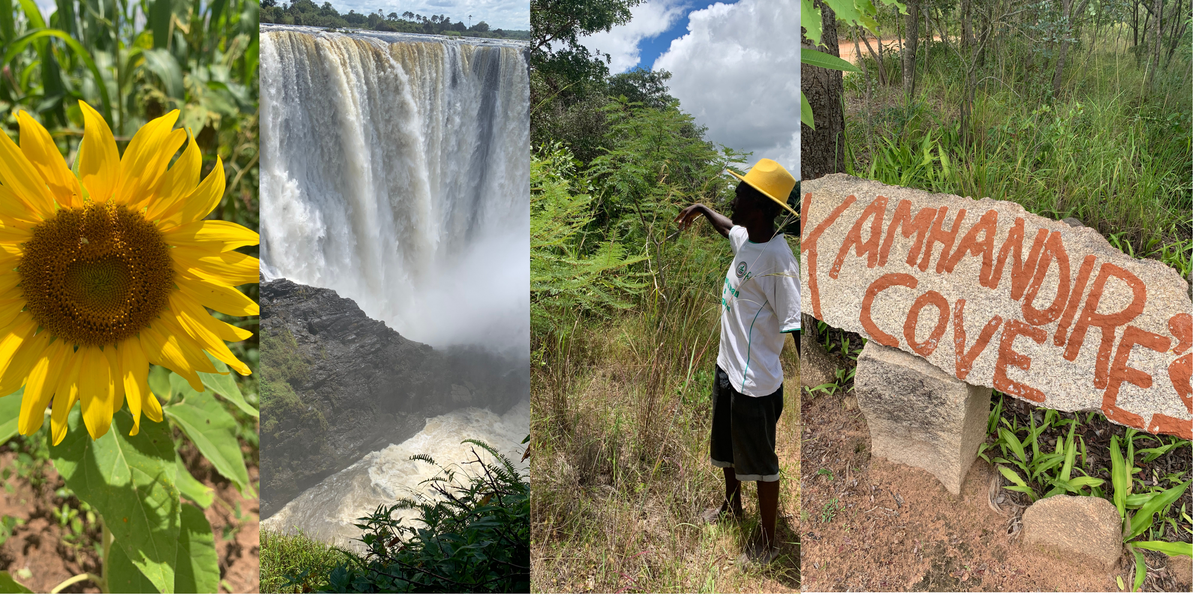
I would love to start by thanking those generous people who put monies into the wee crowdfunder I sent around to help me fund this trip to Zimbabwe, your generosity allowed me some ease to flow with what the Road asked of me, it enabled me to see Mosi-oa-Tunya (Victoria Falls) in the best conditions to get optimal drama and rainbows, I had some R&R and soaked up the Sun. I also did a lot more "work" than I had expected; which is never a terrible thing when you LOVE your work and this was the great unexpected surprise, the work of the Mystery bringing hope and joy, kinship and vision, to me in ways I didn't even know I needed. No longer is Earth Hospice an abstract vision and I am no longer alone carrying that vision. Let me tell you all about it...
On my first full day there, my first sunrise and cockerel wake up call in the early hours, the warmth, the colours and the easy pace of life already starting to work on my weary Soul; I was led through the eco-village, Kufunda, where I was staying, to the neighbouring farm by Tino and Tanja. I was greeted there by Elijah and his incredible living vision of a permaculture hospice. The sign on the way in "Kamhandire's Cove" means something like "Old man who likes Corn" which was the nickname of Elijah's grandfather to whom this Cove is dedicated. Why a Cove?
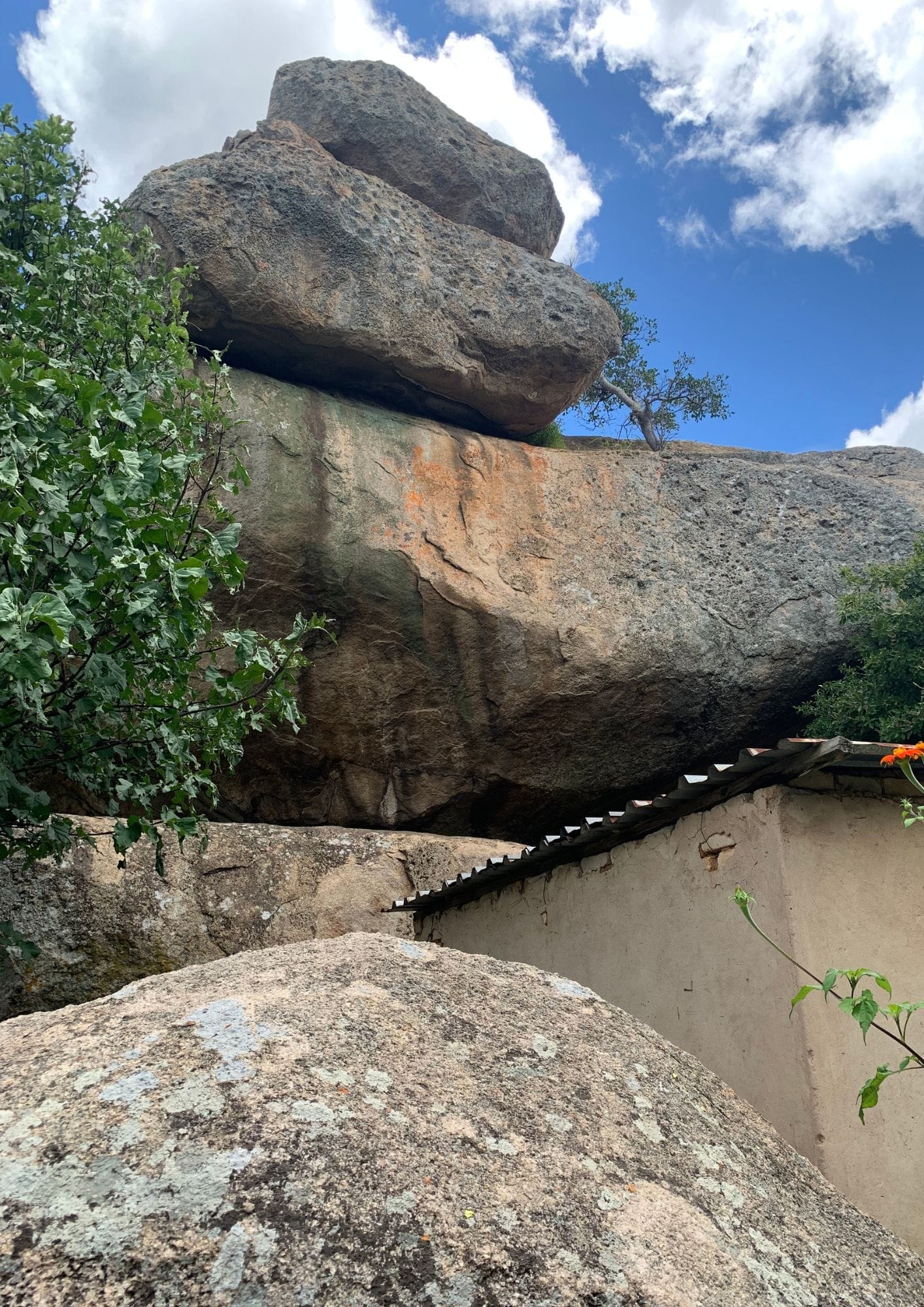
Because it is surrounded by the most incredible and imposing balancing Rock guardians that oversee the Land. At the entrance a labyrinthine garden also greets you with a large bowl of water, a sign says "you do not need to be strong here" and we were invited to symbolically wash our hands and face before we embarked on the tour.
We are accustomed, I think, to building the buildings of a place first and then placing gardens around them but here, the Land and the vision has shown Elijah that he must create the gardens and mark out the spaces for what he calls his "Hospice Village" which is in every last detail exactly the same as the vision I have called "Earth Hospice" right down to Elijah and my convictions that permaculture principles and hospice care are a match made in heaven-on-earth. So we got the tour of the gardens, each with handwritten signs demarking their purpose; amongst the corn and sunflower crops that provide income there are spaces dedicated to a memorial garden and rock walk, a natural burial ground and the hospice village and healing centre itself. So our tour took hours as we wound in and out of the spirals of the gardens, ducking under fruit trees and picking our way through herbs.
Elijah said that the Vision is so large that he does not feel the weight of it, something greater than him must be holding it. This marks him out as kin, for me. I asked Elijah how he came to be a visionary thus? He was once a panel beater and mechanic but took work in Funeral Service. In modern day Zimbabwe it is common for most people to die at home, some die in hospital, and for the dead to be taken to a funeral home to be laid out before being returned to.their home for the wake. This is what Elijah was doing when he realised that the land of his grandfather "Kamhandire" was asking for something more sustainable and organic; something that kindled the Village. One of the many reasons I travelled to Zimbabwe not "on the business" but raising the funds myself and not in work capacity was that I was not sure at all how the Journey with Death work was needed or wanted in Zimbabwe; a place where community, mutual aide and grassroots care of the dying is very much the norm. It was bittersweet to discover that my work is very welcome there.
On the plane of the way there my neighbouring passenger was drunk. He was extremely amicable and welcomed me to Zimbabwe and told me all about the various enterprises he had going on at his rural farm. When he asked me what I did for a living and I told him, he reeled and drunk-whispered (ie loudly) "that's white people's problems!" and he declared with great pride that he would never put his mother in a care home (which stung) and he said "when my mother dies, my wife will take care of her". Then he passed out drunk to the point that if I needed to the loo I had to climb over him with the help of the cabin crew! This exchange gave me a snapshot into the predicament of where the "old ways" meet the "new ways". This gentleman, with his tendency to self medicate with booze, was travelling to fund a home life that he was sure would take care of his mother. I had told him that my mother died in a care home because I couldn't care for her at home "because she screamed all night"; "she screamed all night" he said "because you didn't have children". And, he wasn't wrong (in that she and I had ancestral trauma to tie up); thank GOD I don't have children.
So, Zimbabwe does not have a national health service or social care services unless you can pay for them. The villages might care for their dying in more rural areas but the closer you come to the Big City the more expensive life becomes. I have never spent money quite like in Zimbabwe, a cash based culture dealing in US dollars and they flew out of my purse to goodness knows where; mostly on transport but also on a million small things that would not be denied. It scared me, how money just seemed to disappear even when I was staying in a very low cost, sustainable place where fresh vegetables were easily on hand. The lack of infrastructure in general is just expensive and the country has an unemployment rate of 89% I was told. So, where aunties and uncles, grandmothers and grandfathers need adequate housing, healthcare and infrastructure to support them many younger people are working away from home to send money back to them. You can finance your parents or you can care for them yourself but you cannot do both (same in my situation too when caring for Mum).
Whereas here in the UK and across Europe the Earth Hospice vision is about reclaiming hospice from the medical profession and placing it back into community and landscape; in Zimbabwe the need for hospice is growing and the opportunity at Kamhandire's Cove is to develop a model that retains the values of the old ways, the values of community and connection to land and landscape; as a beacon for a better way to do it than to closet people away in clinical and / or church based institutions. Elijah has a business partner Gram who is a herbalist; there is an openness and embracing still in Zimbabwe of the traditional healing methods that sit alongside allopathic medicine.
I wasn't even half way through the tour of Kamhandire's Cove and the words were out of my mouth to Elijah, I proposed a "learning exchange partnership" between our two social enterprises. 5% of profit from Sacred Circle Training Co CIC would come to Kamhandire's Cove along with any experience and support we have to contribute to how hospice could really serve community; and in exchange they will host us and offer their experiences and models as inspiration to our Earth Hospice movement. We shook hands on it, then embraced.
I told Elijah of the origins of hospice; a story he hadn't heard before. That the original hospices were along the pilgrimage routes; safe places with a fire, food and place to rest for weary pilgrims. Spiritual places, places of healing but importantly also of community and of hospitality. The word "hospice" has its roots in the same place as "hospitality"; these places are hearths for the community. They were not originally necessarily places to die in but hubs of care and community; a True Hospice fit for our modern times would be grassroots community first, secular and inclusive of all faiths and beliefs, still spiritual in the sense that death is sacred, grief is sacred, but without dogma or hierarchy. Modern western medicine making a better servant than it does master would have a place in these settings but only in the same way it does when people die at home. There's no need for the overheads of a medical, clinical, premises at all; and we again, if anyone is in charge of the dying process it would be the dying person themselves.
Neither in Elijah's vision or mine are these Earth Hospices solely about caring for people in their last days; that would simply be a part of it. These hubs are about gathering, about grief consciousness and death literacy, bringing communities together to unlearn their fear of death and loss, to mourn together, to pool resources and support each other. I was invited by my host Tanja to lead a workshop at the Friendship Bench Hub in Harare on Griefwork in Community and it was well attended and well received. As I talked about the connections between personal, collective and systemic death and loss the impact of colonisation and capitalism renders itself very clear; the abandonment of our dying, dead and bereaved is both cause and effect of our deep fear and denial of death; which is directly connected to our loss of connection to land and landscape.
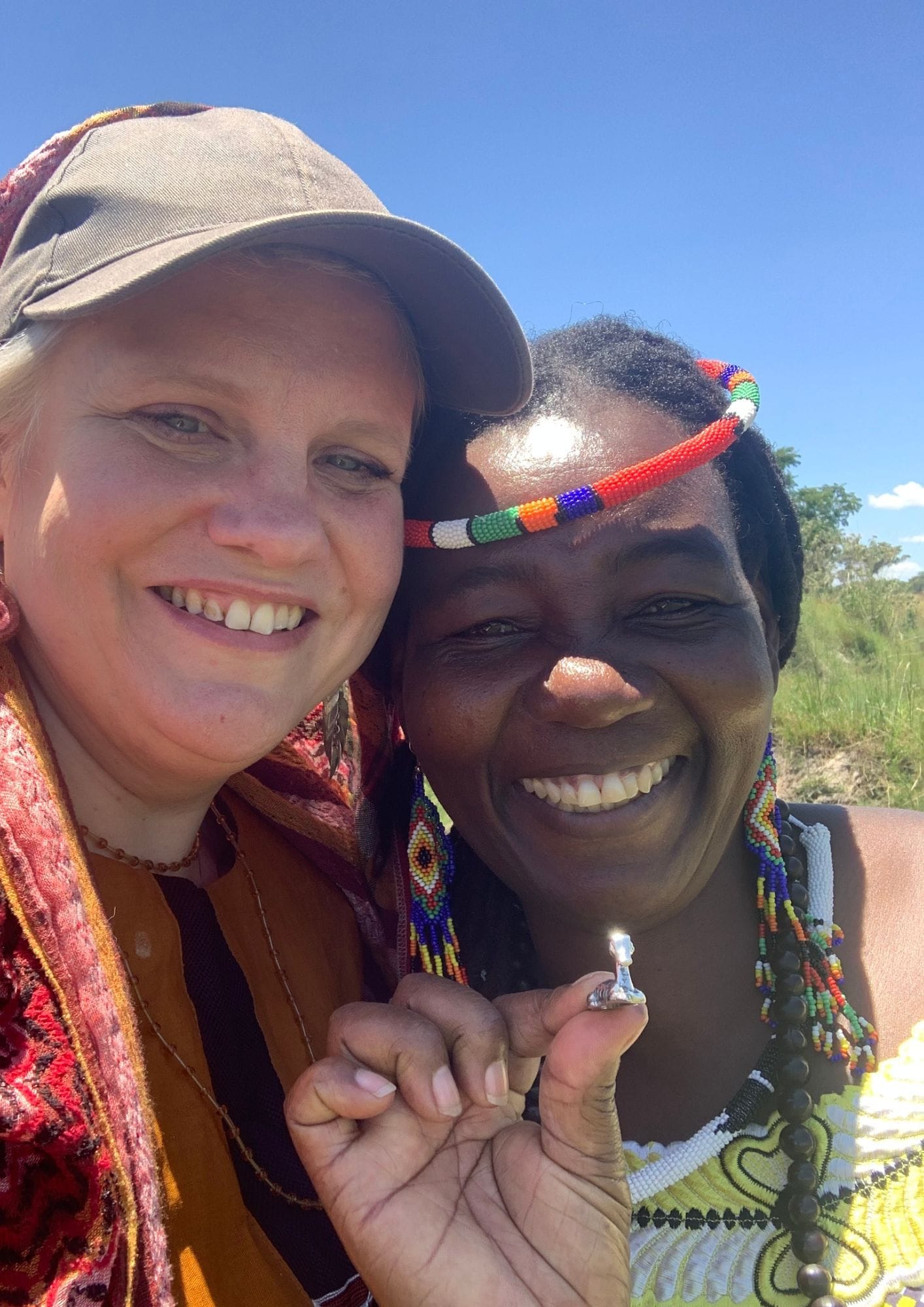
While I was staying at Kufunda I also met Shean who lives out near Mutare on the eastern edge of Zimbabwe. Shean was widowed young and now has a widow's village taking care of women and children left behind by the death of the breadwinner. I met at Kufunda young gay and transgender people some who are not always welcome back home and have a difficult relationship with their parents. These are the outliers in the model of village care given to me by my drunken friend on the plane; it works when your wife takes care of your mother when you have a wife, and she is resourced by you.
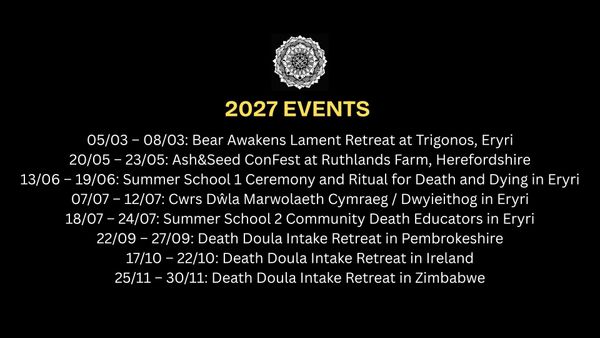
After sitting in the great Dare hall at Kufunda and singing, lamenting and sharing with people who gathered there I knew that I could bring the Death Doula retreat there and it would be well received. So in August 2027 I will be doing exactly that bringing people from abroad to Zimbabwe who need to hear Shean telling us about the Shona death rites, the long nights of lament by the womenfolk, the burial traditions and we will also welcome Zimbabweans to come and also have the space for gathering and story sharing and exploring relationship to death and grief in these changing times. I am really glad, deeply humbled and incredibly grateful, that I got the chance to go and introduce myself to the Land and to get a felt sense of how a white European should tread in a landscape with such tense and terrible colonial history and such pressing legacies of empire that show still today. There is no real need to teach anybody anything as in the colonial model of education but rather allow the gathering and the sharing to be the crucible, where stories lead us and Death is the Teacher. If you feel called to join us in August 2027 at Kufunda the places are open to new applications and existing doula prep participants of the Journey with Death. When the course is ready for sign ups I will offer the course first to European people with African heritage; then a second round will be open to all. If you wish to be kept informed please email sacredcirclecic@gmail.com with the title Zimbabwe Doula Prep as the subject line.
AND... back to Earth Hospice. Many of you who have been following this work for some time will know that I have twice tried before to create a legal entity and crowdfund the costs of establishing the first Earth Hospice. Everything has now changed for me. Earth Hospice is already realising itself under Elijah and Gram's stewardship; so I am not the first and I am delighted by that. I have also realised there are a couple of reasons the previous crowdfunders were not successful - in both cases we focussed on a particular building and land and if people did not have a personal connection to.that building they perhaps didn't feel inclined to contribute. The other obstacle created by that approach was the timescale - when a property is already on the market then we are backs-against-the-wall pushing it to make a deadline and secure the property before someone else does. AND we have been crowdfunding for the whole costs, which meant an impossible target for some to imagine us meeting.
Recently a property and land on the pilgrims way very near my home surfaced as a potential Earth Hospice, it is months away from going on the market with a price of around £400k. I don't know whether this is The One or not but what it did do was lead me towards enquiring of a mortgage company Ecology Building Society, whether the Sacred Circle Training Co CIC might be eligible for a commercial mortgage? And to my surprise WE ARE! The thing that I am most proud of and the thing that makes us most bankable is that we have now been trading in some form for 10 years and 8 years as the social enterprise. Keeping this social enterprise afloat through the pandemic and caring for my mum remains one of my greatest achievements just personally but when I heard this from Ecology I was elated. Most businesses fail in the first 3 years. This year Sacred Circle CIC moved out of debt and into profit; which I am delighted to celebrate by sharing said profit with Kamhandire's Cove by way of Tithe. But it also means that we are a good bet for a mortgage. Additionally we also have evidence that we spend between £25k - £30k per annum on retreat centre venue costs; which would immediately be able to be saved and put into Earth Hospice if we were able to offer retreats from there.
The business model that was developed for the last round of Earth Hospice crowdfunding for the Cloisters in Llanallgo will easily adapt to any property where there is a building in relatively good repair. Essential to the survival of Earth Hospice is its sustainable business model instead of grant dependence. This is why Elijah growing corn and sunflowers is so important. The Earth Hospice must be run as a social business with community investment to be independent, neutral and sustainable. As a social entrepreneur I say that grant dependency is the death knell for any community based endeavour whether a charity or social enterprise. We MUST have community buy in (skin in the game) and we must operate a profitable business plan, where profits are returned to the community. We are in this place now I am happy to say. All we need is a deposit. The deposit made up with community donations is the ethical and ideological bedrock of this project. Welcome as large investment from angels might be, we still want the People to put in the pennies, so we have the love, heart and support of the community at large.
So what can YOU do to get involved? Well, I am excited to share this Zeffy link with you. It is a different kind of crowdfunded and yes, it involves a leap of faith, we are asking people who believe in the VISION to invest and you may not yet know what in. Having tried twice to target a particular property it is now clear to me that we need to see the colour of the money of our community support; to have the community collateral upfront so we can MOVE when the right place comes on the market. Zeffy allows you to make either one-off or monthly / annual contributions, to cancel at any time and to track progress towards our goals. Zeffy has 0% fees, is completely free for us to use and relies on donations from contributors which are voluntary.
I monitor land sales and see regularly that parcels of land come up for sale at less than £400k but I am using my friend's farmhouse and land as a benchmark to give us our funding target. We would love to raise at least 25% of that, £100k and an additional £25k for legal fees and move in costs = £125k within 6 months of now. If we do not, your money is not lost, we will go again and raise more... and if we end up with £25k we can look for land for sale for £100k... if we get £75k we can look for properties with land for £300k. We can tailor our approach based on the level of community buy in and support. PLEASE join us in visioning for the full amount so that we can move with confidence to purchase land for community benefit and create Earth Hospice here while we also support and uphold the work being done by our Zimbabwean kin.
 Zeffy
Zeffy